
How to use ThermaPets.
Instructions & progress trackerThe basics are below. Add your pet to open their session details and day 1, 7 and 14 tracker.
The basics
- Pick a quiet moment. When they’re relaxed, ideally lying down.
- Part the fur. So the light reaches the skin.
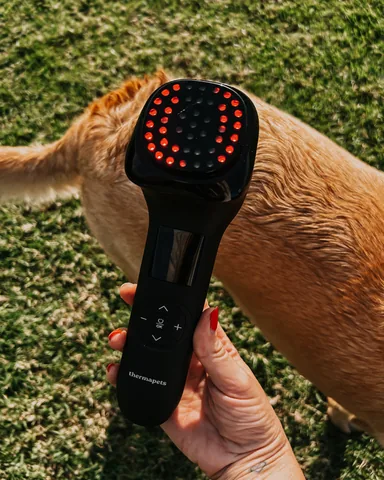
- Glide in slow, small circles. Rest the device gently on the coat and keep it moving.
Follow the user guide in the box for settings and session length.
Please don't use ThermaPets
- Near the eyes, whether yours or your pet's. Never shine it towards a face.
- Over lumps, growths or known cancer.
- Over the belly of a pregnant pet.
- On young, still-growing pets' joints, unless your vet says it's fine.
- Pressed onto an open wound or fresh stitches. Hold it just above instead.
Make it personal
Who are we caring for?
How big are they?
SizeChoose the size that matches your pet. You can review your other answers on the next step.
What would you like to help with?
Your use guideChoose your areas and review the use-safety checks before opening session instructions.
Check for warning signs
Which areas apply?
Choose everything that applies. We’ll group the areas into your guide.
You can continue now. You can explore the device, watch the product video and review buying options.
Explore ThermaPets.
Your product overviewA handheld red & near-infrared light device for home use, with a built-in display and controls.
See how it fits into their care.
Here are the areas you selected, ready to discuss with your vet.
Illustrative guide · Confirm suitability, areas and settings with your vet and device manual before use.
Keep away from eyes, lumps, known cancer and a pregnant pet’s belly. Check with your vet about growing joints. Never press onto wounds or stitches. Stop if your pet moves away, flinches or the area feels hot.
Your full how-to guideSession details, instructions & progress tracker
Supplied guide preview · Follow your vet’s instructions and the device manual.
5 minutes per area, split evenly between the left and right side of the body.
Your session, step by step
For each concern
Before you start
Choose a quiet moment when they're relaxed, ideally lying down. Part the fur so the light reaches the skin; a thick coat blocks a lot of it. Pick the level shown in your plan.
During the session
Rest the device gently on the coat and glide it in slow, small circles over each area. Keep moving rather than holding still in one spot. Most pets find the warmth soothing and settle quickly.
If they move away, flinch, or the area feels hot under your hand, stop and check with your vet before continuing.
Safety first
Please don't use ThermaPets
- Near the eyes, whether yours or your pet's. Never shine it towards a face.
- Over lumps, growths or known cancer.
- Over the belly of a pregnant pet.
- On young, still-growing pets' joints, unless your vet says it's fine.
- Pressed onto an open wound or fresh stitches. Hold it just above instead.
General guidance for home use. Always read the ThermaPets user guide that comes in the box. Scores are observations, not a diagnosis or proof of treatment effectiveness.
Keep track of what you notice
They can't tell you, so watch what they do.
Score each sign today, before the first session, then again on day 7 and day 14. Tap a box to change it.
No change by day 14, or anything getting worse? Stop and talk to your vet.
All conditions & reference information
Red light therapy for dogs, cats and horses: where, how long and how often
ThermaPets combines red light (650–660 nm) and near-infrared light (800–810 nm) in one handheld device. It’s a drug-free way to support your pet at home, alongside your vet’s care. Give each area 5 minutes, split between left and right, so a session takes 5–10 minutes for one or two areas. Treating three or four areas? Do a morning and an evening session. More than that, alternate between two sets of areas on different days. Every pet is different and results aren’t guaranteed.
Arthritis and stiff hips in older dogs
Arthritis is one of the most common reasons owners start red light therapy. Regular sessions over several weeks work better than occasional long ones. Vets typically start arthritis patients with 2–3 sessions a week.
Where: Hips and knees, on both sides. Level: Level 2 for small and medium dogs, Level 3 for large and extra-large. How often: Every other day for 6 weeks, then 1–2 times a week to maintain. Signs to watch: getting up after lying down, stairs or jumping into the car, stiffness in the back legs on walks.
Elbow and shoulder stiffness
Front-leg stiffness often shows as short, choppy steps or reluctance after lying down.
Where: Shoulders and elbows, on both sides. Level: Level 2, or Level 3 for large dogs. How often: Every other day for 6 weeks, then 1–2 times a week. Signs to watch: stride length, limping after a rest, going down stairs or off furniture.
Back pain and spinal stiffness
Glide slowly along the muscles that run beside the spine.
Where: Either side of the spine (not directly on it) and the lower back. Level: Level 2, or Level 3 for large dogs. How often: Every other day for 6 weeks, then 1–2 times a week. Signs to watch: reaction when you stroke along the back, a hunched posture, jumping up.
Neck discomfort
Switch to a harness while the neck is sore.
Where: Along both sides of the neck. Level: Level 2. How often: Every other day for 6 weeks, then 1–2 times a week. Signs to watch: lowering the head to eat or drink, turning to look at you, comfort with a collar or harness.
Sore wrists, ankles and paws
Where: Wrists, front paws, hocks and back paws. Level: Level 2. How often: Every other day for 6 weeks, then 1–2 times a week. Signs to watch: licking paws or joints, short careful steps, walking on hard ground.
Muscle soreness after exercise
A good post-hike or post-agility ritual for active dogs.
Where: Thighs, shoulders and lower back. Level: Level 2. How often: Within 2 hours after exercise, then again the next morning. Signs to watch: stiffness the morning after, energy for the next walk, keenness to play.
Sprains and strains
If your dog suddenly can’t bear weight, see your vet first.
Where: The injured area plus a hand’s width around it. Level: Start on Level 1; move to Level 2 if it isn’t tender after 2–3 sessions. How often: Daily for the first week, then every other day. Signs to watch: putting weight on the leg, limping, swelling or heat at the spot.
Recovery after surgery
Never press on stitches. Always get your vet’s go-ahead first.
Where: Around the incision, held 1–2 cm above the skin, plus the supporting muscles. Level: Level 1. How often: Once your vet says yes, daily for the first week, then every other day until healed. Signs to watch: putting weight on that side, licking at the wound, moving around comfortably.
Wounds, hot spots and skin irritation
Clean the area before each session.
Where: The affected skin, held 1–2 cm above with no contact. Level: Level 1. How often: Daily until healed. Signs to watch: size of the sore area, redness or weeping, licking or scratching.
Using red light therapy on cats
Cats can benefit too, especially older cats with stiff hips, back or knees who stop jumping onto furniture. Use Level 2 on the same areas as for dogs, with the same 5 minutes per area. Most cats prefer short, calm sessions on their favourite spot.
Using red light therapy on horses
Horses get the same 5 minutes per area, on Level 3 for most horses (Level 2 for ponies). The areas owners treat most are the back and saddle area, neck and poll, hindquarters and stifles, hocks, and the front tendons and fetlocks. For arthritis or a sore back, work every other day for 6 weeks, then 1–2 times a week. After hard work or a competition, treat once your horse has cooled down. Larger areas like the hindquarters can be covered in a few 5-minute sections. If your horse is suddenly lame, call your vet first.
How to tell if it’s working
Your pet can’t tell you how they feel, so score what you see. Use the guide above to get a personal plan with a day 1, day 7 and day 14 progress tracker. No change by day 14, or anything getting worse? Stop and talk to your vet.
Safety
- Never shine ThermaPets near the eyes, whether yours or your pet’s.
- Don’t use it over lumps, growths or known cancer, or over the belly of a pregnant pet.
- Check with your vet before using it on young, still-growing pets’ joints.
- Hold it above, not on, open wounds and fresh stitches.
Your answers and tracker stay in this browser tab for up to 24 hours. Download your guide to keep a copy.
Bring a little care home.
ThermaPets device + user guide
R2,799Includes a free leash + ball until 31 December 2026, while gift stocks last.
Continue to purchaseHow you’d use it at home
- Make a quiet moment. Settle your pet somewhere comfortable.
- Use the display and controls. Follow the user guide for placement, settings and session instructions.
Before using the device
Keep away from eyes. Never press onto wounds or stitches. Stop if your pet moves away, flinches or the area feels hot.
How the technology works
Device details
Red light: 650–660 nm. Near-infrared light: 800–810 nm. Device dimensions: 3 × 8 × 20 cm.
Explore the device in detail →